
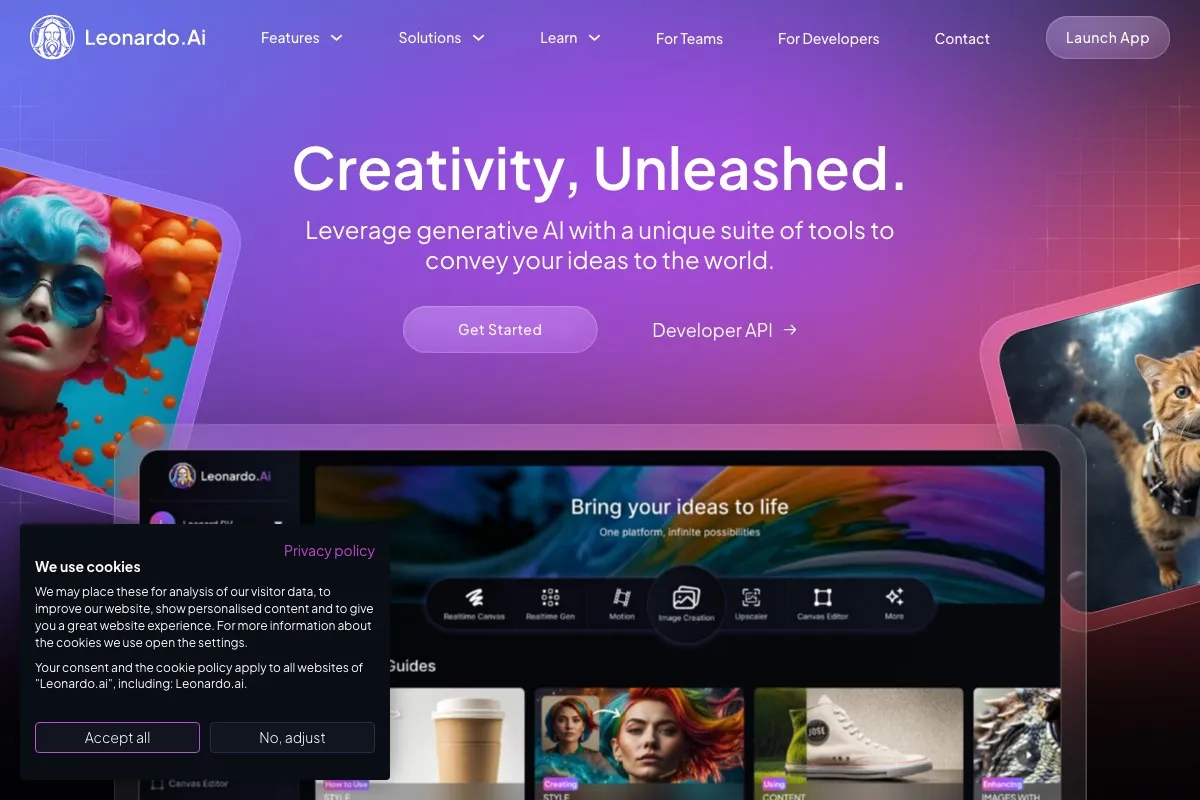
Leonardo AI is a creative platform for making and editing images and video, with tools for individual creators, teams and developers. It addresses a common production need: moving from a written prompt or an existing visual to generated, revised and upscaled assets in one service. Users can choose among listed models for different image and video tasks, train custom models, and use team features or APIs when work involves collaboration or integration.
What can Leonardo AI do?
For image creation, Leonardo AI generates from prompts and custom models, with selectable models for different use cases. Its catalog includes third-party and Leonardo models for image generation, editing and video. Video generation supports text or image inputs. Editing tools work on images and video while aiming to preserve elements such as characters, composition and style.
- Upscale uploaded images from 2× to 8× with Pro Upscaler Precise or Creative modes.
- Train custom models; paid individual tiers list allowances of 10, 20 or 50 personal AI models.
- Use APIs for image and video generation, including text-to-video and image-to-video workflows.
- On team plans, share tokens and private team generations, and use collections and real-time Canvas actions.
The API also supports custom fine-tuned model training and generation using a trained model ID. Usage metering and cost tracking help developers monitor usage; top-ups are supported for usage-based billing. Teams can use shared token allowances, while individuals can select from tiers with different token banks, model access and generation concurrency.
Who is Leonardo AI best for?
It suits creators who need prompt-based image or video generation, image editing, upscaling or custom model training. Teams may prefer its shared tokens, private team generations, collections and Canvas actions when several people need to work within one plan. Developers building generation into a workflow can consider the APIs, which include image and video workflows and usage tracking. The right fit depends on the required privacy, model access, volume and whether the work is individual, collaborative or API-based.
Leonardo AI pricing in brief
Leonardo AI uses a freemium structure: a free tier sits alongside paid individual and team options. Individual tiers vary by token allowance, model access, personal-model limits, concurrency and selected relaxed-generation allowances. Team options use shared tokens and team features, with a custom configuration also available. API access is usage-based rather than a fixed per-generation rate, and cost depends on the chosen models and features.
Limitations to know about Leonardo AI
Free-tier model access is Auto-only and creations are public; private creations and broader model access are listed on paid tiers. Relaxed unlimited generation is restricted to selected models, and concurrency or queueing may slow based on demand. API costs vary with the models and features used, and the official materials do not give one universal per-generation price. The Pro Upscaler’s Creative mode can change image details, with more creative latitude at larger enlargement factors.
Alternatives to Leonardo AI
For a separate image-generation option, compare Adobe Firefly, which also offers prompt-based image creation, or Midjourney as another tool in the image-generation category. These links offer a starting point for comparing services; check each product’s current capabilities and terms before choosing. Leonardo AI’s own scope also includes video generation, editing, upscaling, team functions and APIs, so compare the specific workflow you need rather than image generation alone.


