
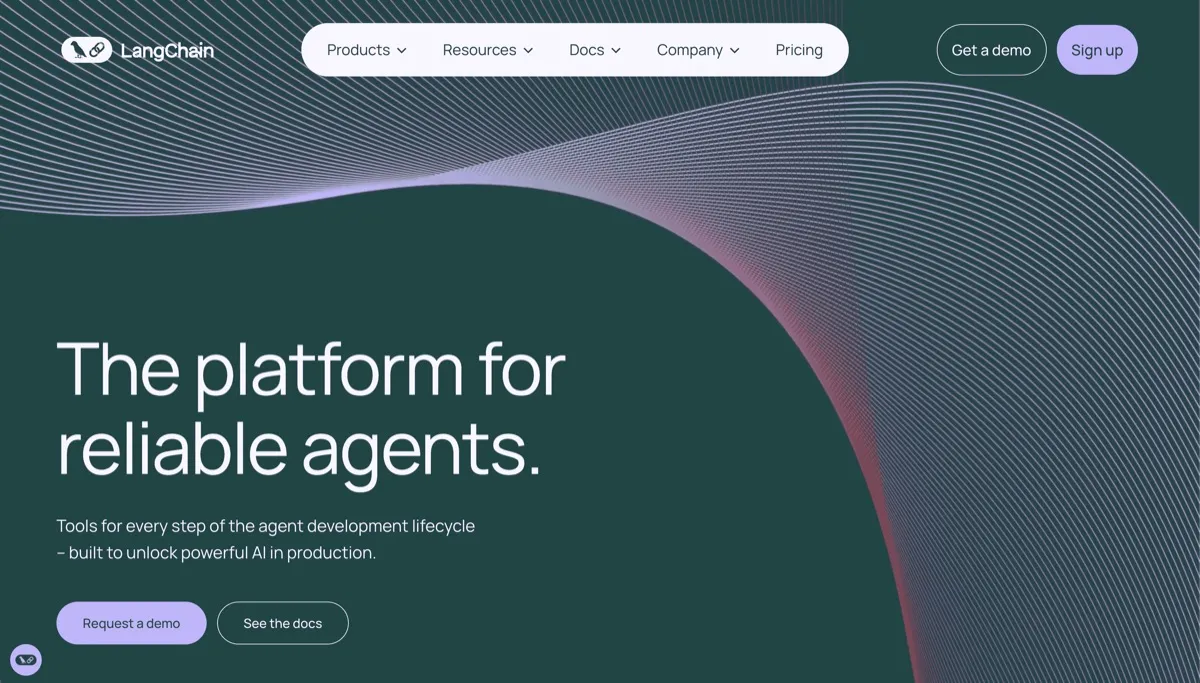
LangChain is an open-source framework for developers building agents that connect language models with tools and data. It addresses the work of assembling those parts into an agent: the framework provides a pre-built architecture and an API for creating agents, while letting developers change models, tools, and databases as their needs evolve. Python developers can use its documented library, and an equivalent JavaScript and TypeScript library is available. LangChain is a developer framework, not a ready-made no-code application.
Teams can use the framework on its own or pair it with LangSmith, a separate commercial product for working with traces, evaluations, and deployments. That distinction matters when comparing what is included in the open-source library with the monitoring and operational products available through LangSmith.
What can LangChain do?
The framework provides a pre-built agent architecture, the create_agent API, and integrations for models, tools, and databases. Developers can swap these components and use middleware to extend agent behavior. The official site states that the framework has more than 1,000 integrations. Its agents run on LangGraph’s durable runtime, which supports persistence, rewind, checkpointing, and human-in-the-loop workflows.
LangSmith adds tools for observing and improving agent applications. Its listed capabilities include tracing, monitoring, analytics, evaluations, dataset collection, annotation queues, prompt management, and bulk export. Deployment supports long-running agents and includes streaming; the listed serverless capabilities include scale-to-zero. Engine monitors traces, groups behavior into issues, diagnoses code failures, and recommends prompt or code fixes.
- Build an agent with the provided architecture and create_agent API.
- Connect models, tools, and databases, then adjust them or extend behavior with middleware.
- Use durable runtime capabilities including persistence, checkpointing, rewind, and human review.
- Use LangSmith to trace and evaluate applications, collect datasets, and manage prompts.
Who is LangChain best for?
LangChain is suited to developers who want to build and customize agents in code, rather than select a ready-made no-code application. It can fit projects that need interchangeable models, tools, and databases or agent behavior extended through middleware. Teams that also need tracing, evaluation, or deployment capabilities can consider the separate LangSmith products. Developers should account for provider and service charges outside the free framework.
LangChain pricing in brief
The open-source framework is free to use. LangSmith has a free individual tier, paid per-seat access, custom-priced enterprise access, and an application-based startup option with variable pricing. LangSmith usage beyond included trace amounts is pay-as-you-go, and deployment compute and database resources are metered. Check the plan details for seat limits, included allowances, and capability availability before estimating costs.
Limitations to know about LangChain
LangChain requires coding and is not presented as a ready-made no-code application. The free LangSmith Developer tier is limited to one seat, and some capabilities have plan-specific limits or are unavailable on that tier. Traces beyond included monthly allowances and additional product usage can incur metered charges. Deployment compute and database usage is measured in LangChain Standard Units, so actual totals depend on agent work and resource use. Startup pricing varies, while Enterprise pricing is custom.
Alternatives to LangChain
For a visual way to build AI flows, LangFlow is a related option to compare with a code-first framework. Botpress is another tool to consider when looking for a platform for building bots and conversational experiences. If the goal is connecting services and automating workflows rather than building an agent framework, orq offers a different workflow-oriented comparison. These tools serve adjacent needs; compare their current capabilities against the project requirements.


